
Navigating EPA Regulations for Workshop Wastewater in Australia
Environmental compliance is a strict legal requirement enforced by state Environmental Protection Authorities (EPAs) and local water utilities across Australia. For heavy diesel mechanics, manufacturing facilities, and automotive workshops, the management of liquid trade waste—specifically hydrocarbons and chemical solvents—is under intense regulatory scrutiny.
Ignorance of the law is not a defense. Understanding how your parts washing equipment interacts with these regulations is critical to avoiding heavy fines and operational shutdowns.
Understanding Trade Waste and EPA Guidelines
Under state legislation such as the Environmental Protection Act 1994 (QLD) and the Protection of the Environment Operations Act 1997 (NSW), businesses are strictly liable for the environmental impact of their liquid waste.
Wastewater generated from cleaning mechanical parts is classified as liquid trade waste. Local water authorities (such as Sydney Water, Melbourne Water, and Urban Utilities in Queensland) strictly prohibit the discharge of flammable solvents, heavy hydrocarbons, and untreated degreasers into the municipal sewer or stormwater systems. To legally discharge any wastewater, workshops must hold a formal Trade Waste Approval, which dictates strict concentration limits for oils and greases.
The Regulatory Burden of Solvent Washers
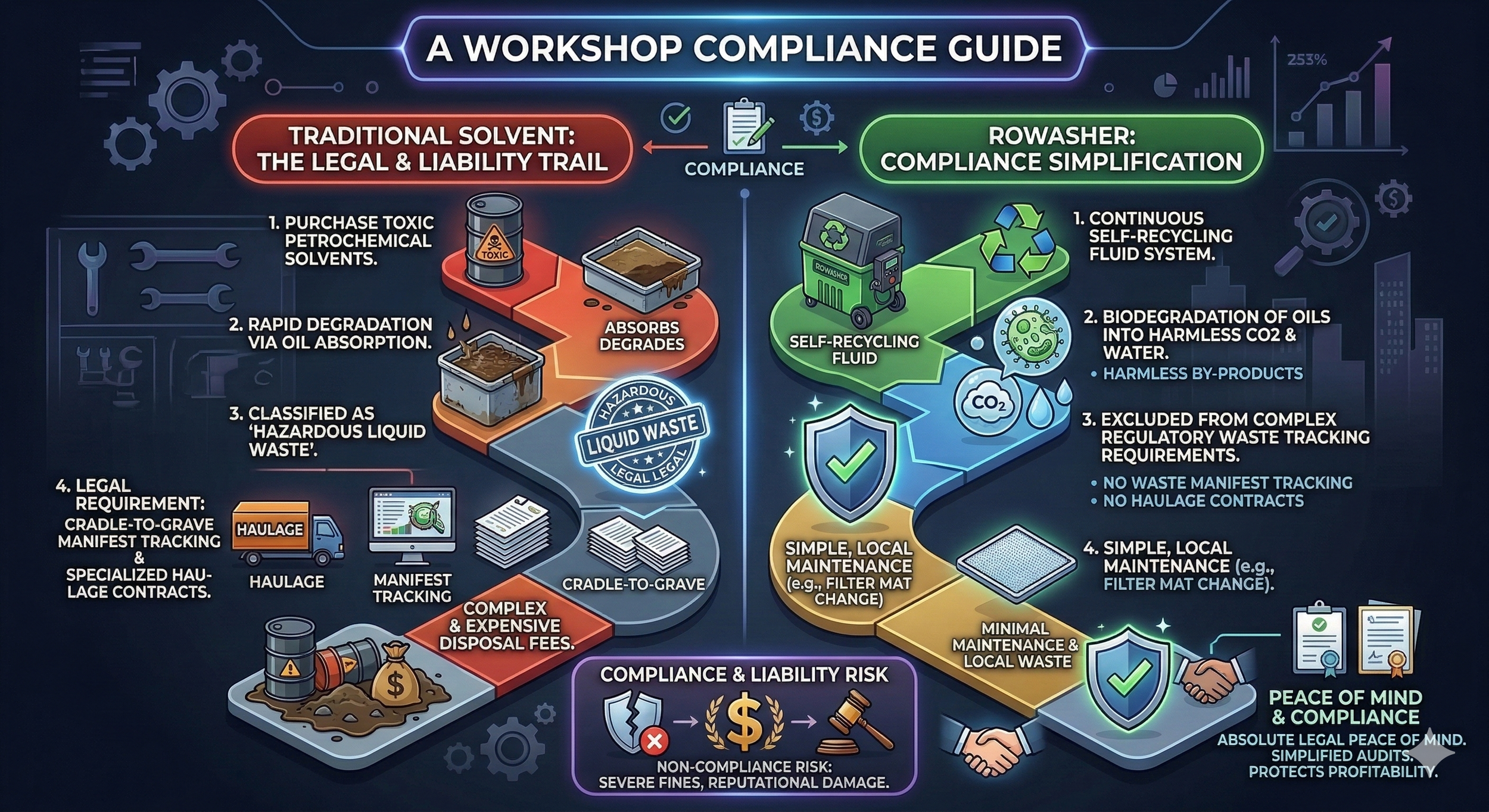
Traditional parts washing relies on toxic mineral spirits and petroleum naphtha. When this solvent becomes saturated with grease, it is classified as Regulated Waste (or Trackable Waste, depending on your state).
The legal requirements for managing this waste are severe:
Cradle-to-Grave Tracking: Workshops must use licensed waste transport contractors and maintain mandatory waste tracking certificates to prove the hazardous liquids were disposed of at a licensed receiving facility.
Financial Penalties: Accidental spillages, improper storage, or the illegal discharge of these chemicals can result in severe financial penalties running into the hundreds of thousands of dollars for corporate entities, alongside personal liability for company directors.
Ongoing Audits: Storing bulk hazardous waste on-site increases your risk profile during routine EPA or local council compliance audits.
Achieving Bulletproof Compliance with Bioremediation
The most effective way to manage hazardous waste compliance is to stop generating hazardous waste altogether. This is the core advantage of upgrading to a ROwasher bioremediating parts cleaner.
The ROwasher operates as a closed-loop ecosystem. It utilizes a water-based, solvent-free degreasing solution paired with Bio-Safety Level 1 microbes. Because these microbes actively consume the removed oil and grease and convert them into harmless carbon dioxide and water, the machine does not generate a toxic liquid waste stream.
By eliminating the production of hazardous liquid waste, workshops can:
Cancel specialized chemical haulage and disposal contracts.
Remove the administrative burden of regulated waste tracking certificates.
Drastically reduce their environmental liability and simplify council trade waste compliance.
Transitioning to sustainable parts washing protects local waterways and ensures your facility exceeds modern Australian environmental standards.
Achieving Bulletproof Compliance with Bioremediation
Simplify your environmental compliance and protect your business from regulatory fines. The ROwasher helps your facility meets the strictest Australian environmental standards by helping to eliminate toxic liquid waste streams.
