
Why Bioremediation Outperforms Traditional Aqueous Washers
When Australian procurement managers decide to move away from highly toxic petrochemical solvents, the conversation usually turns to water-based (aqueous) alternatives. While basic heated aqueous spray cabinets are a step in the right direction for occupational health, they fundamentally fail to solve the underlying problem of liquid waste generation.
The Limitation of Traditional Aqueous Cleaning
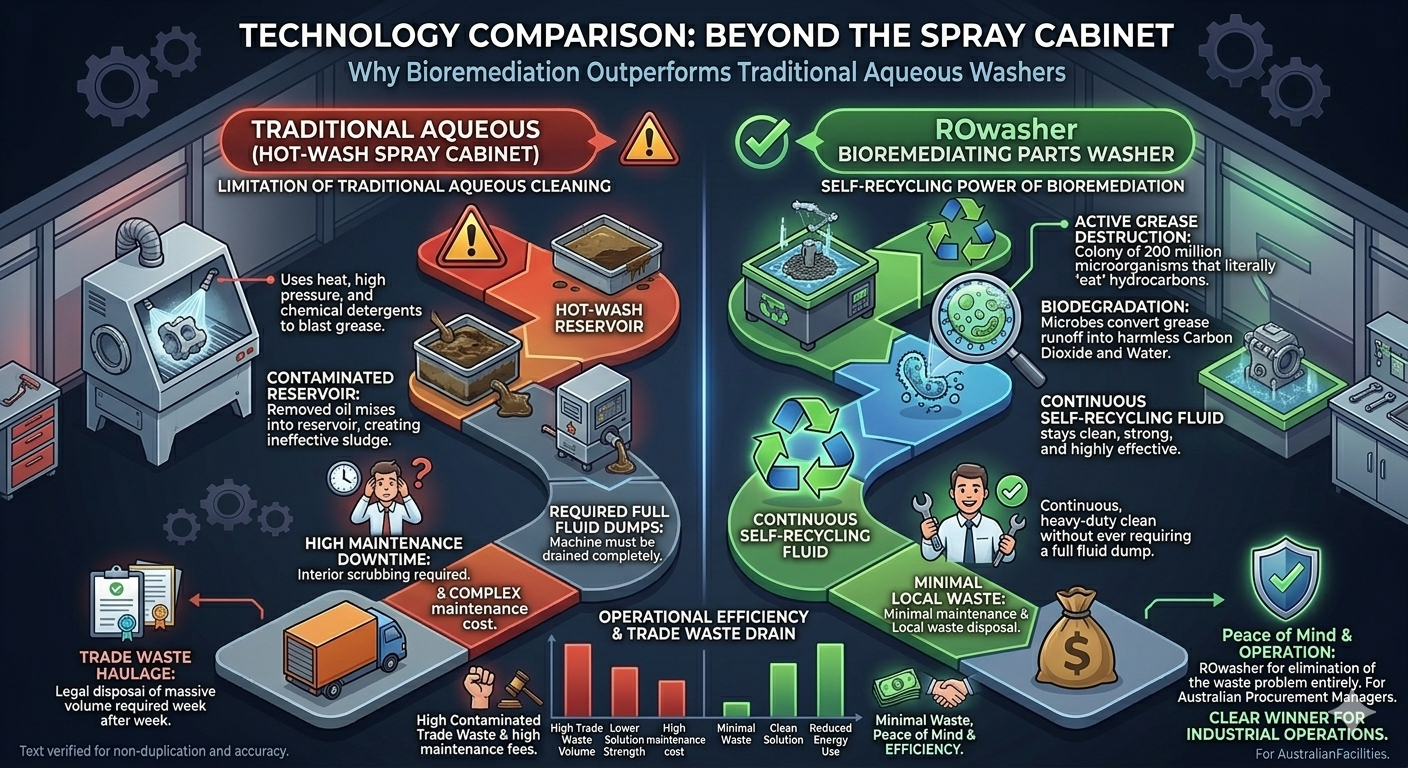
A standard hot-wash spray cabinet relies solely on heat, high pressure, and chemical detergents to blast grease off parts. The critical flaw is that the removed oil, grease, and dirt have nowhere to go. They simply mix into the water reservoir. Within weeks, the cleaning fluid becomes a highly contaminated, ineffective sludge. To restore cleaning power, the entire machine must be drained, the interior scrubbed, and the massive volume of dirty water now classified as contaminated trade waste must be legally disposed of.
The Self-Recycling Power of Bioremediation
A bioremediating parts washer like the ROwasher operates on an entirely different level. It doesn't just knock the grease off the part; it actively destroys the grease.
Instead of allowing oil to accumulate and ruin the wash fluid, the ROwasher utilises a colony of 200 million microorganisms that literally "eat" the hydrocarbons. Because the microbes continuously consume the waste oil and convert it into carbon dioxide and water, the underlying ROwash degreasing solution stays clean, strong, and highly effective week after week.
The Only Choice, ROwasher!
Click Here to View
The Clear Winner for Industrial Operations
Traditional aqueous machines trade a toxic solvent problem for a massive dirty water problem. The ROwasher eliminates the problem entirely. By self-recycling its own fluid, the ROwasher drastically reduces equipment downtime, lowers energy consumption, and provides a continuous, heavy-duty clean without ever requiring a full fluid dump.
